


For years, Asia has been the obvious choice for companies manufacturing electronic products: attractive apparent costs, high volumes, well-established supply chains.
But the balance has shifted.
Between supply chain tensions, rising logistics costs, geopolitical uncertainties, component shortages, and growing expectations for sustainability, more and more companies are asking themselves:
What if reindustrializing electronic products in France became a strategic and profitable choice?
France is investing heavily in electronics, mass production, and industrial innovation. Companies that take the plunge often discover a more agile, predictable, and responsible model. In many cases, this choice is more profitable in the long term.
This article outlines the key steps you need to take to ensure the success of your reindustrialization project in France.

Why reindustrialize France?
Relocating production is not just an industrial decision. It is a strategic choice that transforms your operational model.
Regaining industrial sovereignty
Your priorities no longer depend on factories located thousands of miles away, or on different time zones.
The company gains complete visibility over:
- Actual production capacity
- The schedule and deadlines
- The manner in which each step is performed
- The quality of components and processes
The concrete result: you regain control of your value chain.
Gain agility and accelerate time-to-market
It also means regaining an industrial agility that Asia struggles to offer. A few kilometers replace several time zones. Iterations become rapid, prototypes circulate faster, and adjustments no longer take weeks.
For scalable products, such as those in the IoT, fintech, or any mechatronics project, this is a decisive advantage.
Reducing environmental impact
Finally, manufacturing in France is a powerful lever for reducing carbon footprint.
By reducing logistics distances, and above all by eliminating the use of air transport, the company naturally limits its emissions, while aligning itself with the expectations of consumers and partners.
This is not just a CSR argument: it is proof of commitment that markets increasingly value.
Step 1: Assess your current production
Before considering production in France, you need to gain a thorough understanding of your current model. This diagnostic phase is often revealing: many companies discover that their Asian supply chain is based on a series of historical trade-offs that are no longer aligned with their current challenges.
Mapping the existing supply chain
Mapping the entire supply chain, identifying points of dependency, and analyzing actual costs allows you to completely overhaul your business model.
- Where are the components manufactured?
- Which actors are involved in the assembly?
- What are the points of weakness?
- What is the actual total cost of ownership (TCO)?
This mapping highlights hidden risks: single dependencies, saturated suppliers, sensitive areas.
Assess geopolitical and regulatory risks
The diagnosis must also incorporate a factor that has become unavoidable: geopolitical risk.
A component routed through a country under tension can become a critical bottleneck. Regulations can transform a production area into a risk zone.
Recent examples:
- Semiconductor shortage (2021-2023)
- US-China tensions over technology components
- New European environmental standards (RoHS, REACH)
The key question then becomes: is your current model still sustainable for the next three years?
Step 2: Assess technical and economic feasibility
Reindustrializing your electronic product in France then requires a detailed analysis of the hardware.
Can it be manufactured in France as is?
Does it need to be partially redesigned?
Which components will be available locally?
DFM analysis and industrialization
This is where DFM (Design for Manufacturing) analysis comes in. It allows the design to be adapted for local machinery, but also improves the overall reliability of the product.
Concrete benefits of DFM:
- Assembly cost optimization
- Reduction in default rate
- Facilitation of maintenance and after-sales service
- Improved product sustainability
In many cases, relocation is an opportunity to make the product more robust and profitable.
Benchmark France vs Asie
Financial evaluation is equally important. The unit cost may be slightly higher compared to Asian production, but this additional cost is often offset by:
- logistics savings,
- a reduction in after-sales service costs,
- better control of deadlines,
- and increased flexibility.
The challenge is therefore no longer to compare France and Asia on a per-unit price basis, but on the basis of an overall model of industrial performance.
Step 3: Identify available grants and subsidies
France has made reindustrialization a priority.
Between France 2030, regional aid, the CIR (Research Tax Credit), BPI France schemes, and European programs (Horizon Europe), there are many tools available to reduce the cost of transition.
| Device | Amount | Target | Organism |
|---|---|---|---|
| France 2030 – Reindustrialization | Up to 40% of investments | Relocation, robotization | Bpifrance |
| Rebound Loan | $50,000 to $5 million | SMEs/mid-sized companies | Bpifrance |
| Research Tax Credit (CIR) | 30% of R&D expenditure | Product development | Research Department |
| Regional funds | Variable (€10-50K) | Local projects | Regions |
| Horizon Europe | Depending on projects | Innovation | EU Commission |
| Industry of the Future | Up to 30% | Production tool modernization | ADEME |
How can I benefit from this?
This step is often underestimated, yet it can turn a project from “possible” to “obvious.”
The budgets available for electronics, robotics, industrialization, or R&D can absorb 20 to 40% of the investments related to tooling or product redesign.
💡 Practical tip: Seek assistance from a specialized firm or ask for help from your industrial partner who is familiar with these mechanisms.
Step 4: Select an industrial partner in France
Manufacturing in France means choosing a partner capable not only of assembling, but also of supporting the entire industrial value chain.
Essential selection criteria
A good partner must have:
1. Industrialization expertise
- Ability to conduct DFM analysis
- Skilled in process optimization
- Advice on choosing components
2. Full capacity: prototype → mass production
- Rapid prototyping (less than 2 weeks)
- Pre-production management (100-1,000 units)
- Series ramp-up (10K+ units)
3. Controlled supply chain
- Network of qualified suppliers
- Supply management
- Buffer stocks of critical components
- Full traceability
4. Commitment to quality
- Certifications (ISO 9001, ISO 13485 for medical devices, etc.)
- Online and final tests
- Functional and environmental testing
- Rigorous industrial documentation
5. Proximity and responsiveness
- Possibility to visit the factory regularly
- Direct communication with technical teams
- Responsiveness to emergencies and changes
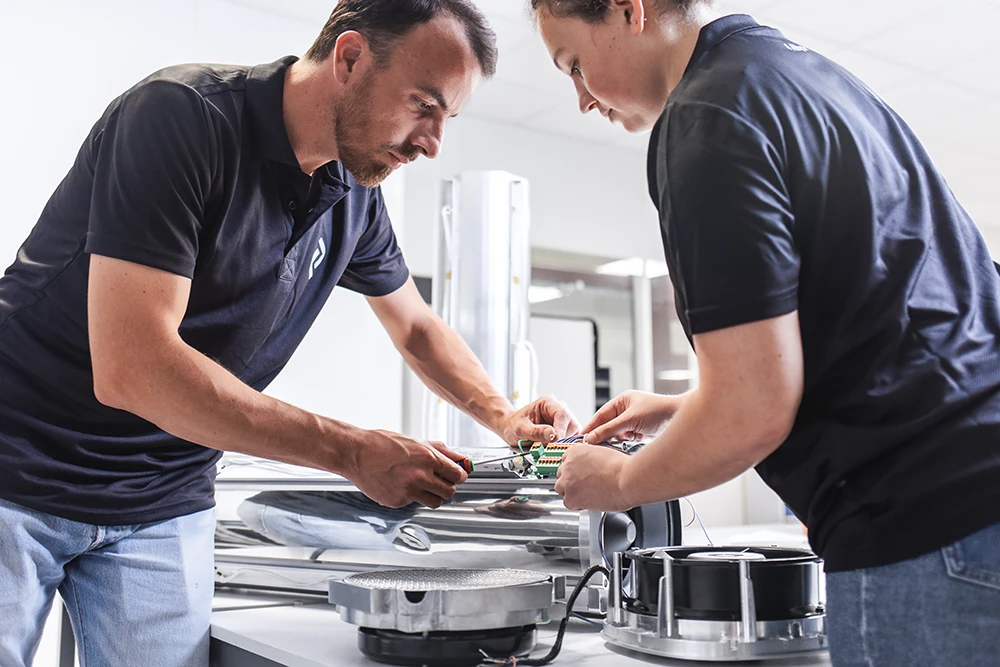
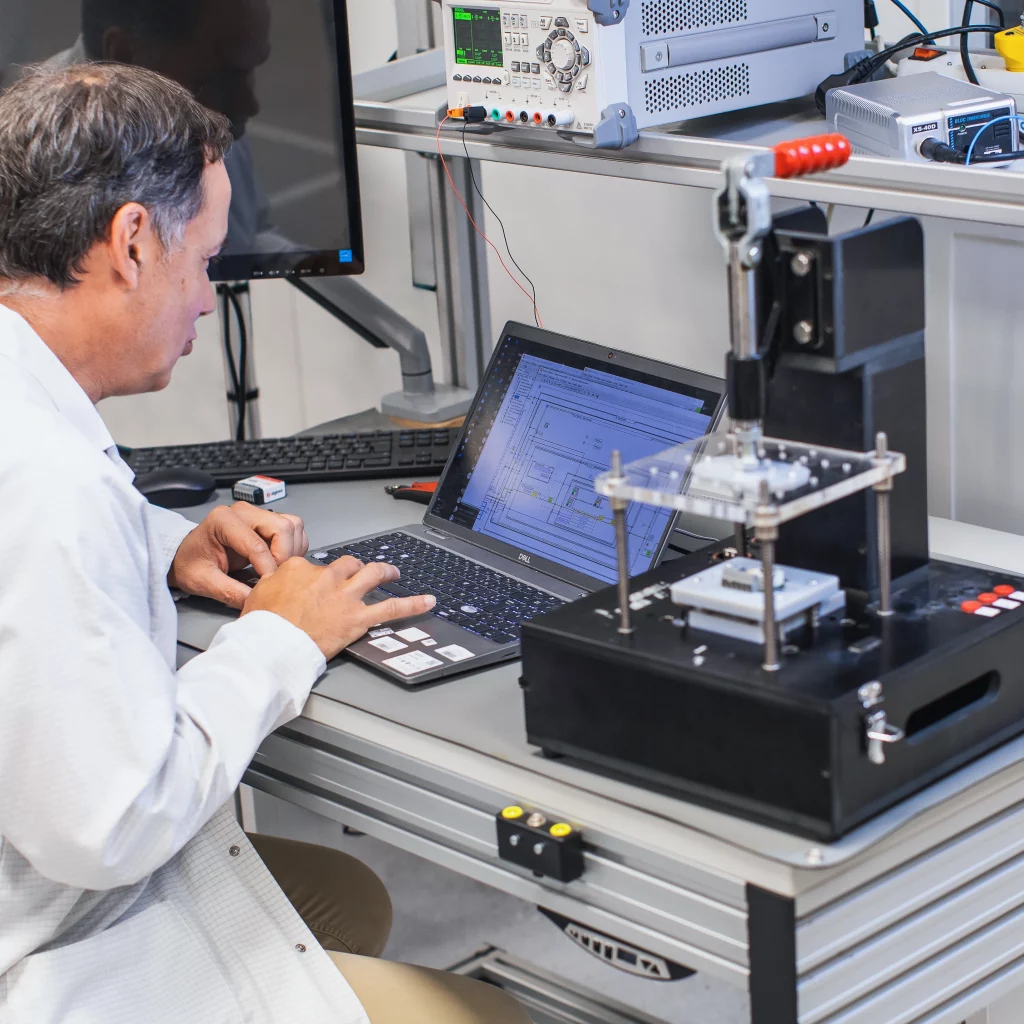
💡 Good to know: Altyor has a production facility in France specializing in electronics, with a capacity of over 100,000 units per year and comprehensive support from prototype to series production.
Custom Quote · Response Within 48 Hours
Get a quote tailored to your project
There’s no magic formula, just an accurate estimate prepared by our experts after we’ve understood your needs.
✓ Response within 48 hours ✓ NDA signed in advance ✓ No obligation
Step 5: Build a reliable local supply chain
Reindustrialization does not mean cutting ties with the international community: it means rethinking the balance.
The goal is not zero dependence on Asia, but controlled dependence.
The local supply chain is gradually being built:
- give preference to European manufacturers and distributors whenever possible,
- secure the supply of electronic components through long-term contracts,
- anticipate shortages and prepare alternatives, in particular via a comprehensive electronic BOM,
- Integrate traceability as a strategic tool, not just a constraint.
This work transforms the supply chain into a competitive advantage: reliable, short, transparent.
Step 6: Industrialize and ramp up production
Once the prototypes have been validated and pre-production stabilized, the factory can prepare for ramp-up.
This is one of the great strengths of French manufacturing: direct communication between the product team and the industrial team allows processes to be adjusted quickly, workstations to be improved, and non-conformities to be resolved effortlessly.
Successful industrialization depends on:
- quality managed on a daily basis,
- rigorous inspection of each batch,
- careful volume management to support growth,
- clear and up-to-date industrial documentation.
Produce in bulk with confidence.
Make or Buy, supplier selection, ER/PR/SR, quality, supply chain, CSR: 16 tips to help you organise your transition to production and maintain your volumes, costs and quality standards.
Reindustrializing electronic products in France is no longer a gamble. It is a concrete response to current logistical, operational, and environmental challenges.
It is also a way to build a more agile and responsible industrial model that is perfectly aligned with the expectations of both businesses and the market.
If you are considering assessing your relocation potential, optimizing your product, or exploring a hybrid France/China production model, our team can support you every step of the way.
FAQ – Reindustrialization of an electronic product in France
Why reindustrialize the production of your electronic product in France?
Reindustrializing electronic products in France allows for better quality control, reduced logistics times, improved product agility, and limited supply risks. Manufacturing in France also helps reduce carbon footprint and strengthens brand credibility with customers.
Is it necessarily more expensive to manufacture in France than in Asia?
Not necessarily. The unit cost may be higher, but savings on transportation, logistics, product returns, quality, and lead times often reduce this difference. The total cost of ownership (TCO) is, in many cases, more advantageous in France.
What are the steps involved in repatriating electronic production to France?
The key steps are:
1- Diagnosis of the current supply chain,
2- Technical and financial evaluation,
3- Industrial redesign if necessary,
4- Selection of an industrial partner,
5- Construction of a local supply chain,
6- Launch of pre-production runs followed by ramp-up.What is the average time required to reindustrialize an electronic product in France?
Depending on the complexity of the product, reindustrialization takes between 4 and 12 months, including diagnosis, possible redesign, pre-production runs, and production launch.
Is there any financial assistance available to fund reindustrialization?
Yes. The France 2030 program, regional aid, the CIR (research tax credit), BPI France schemes, and certain European funding programs can cover a significant portion of the project. Dedicated support is available to help identify eligible schemes.