

More and more industrial and hardware companies are committing to eco-design initiatives.
The intentions are there, as are the first steps: choosing materials, considering product lifecycle, reducing impact.
But when it comes to communicating, doubts arise.
How can we promote this approach without going overboard? How can we be precise without sounding like technocrats? And above all, how can we prevent genuine efforts from being perceived as greenwashing?
Between the desire to do the right thing and the fear of saying the wrong thing, many companies hesitate, fumble around, or prefer to remain discreet.
However, it is possible to communicate credibly about eco-design, provided you have the right tools, the right evidence, and a structured approach.
Environmental claims: what regulations allow (and prohibit)
Communicating about eco-design is not simply a matter of storytelling.
It is a practice governed by specific rules, designed to protect consumers from misleading or inaccurate messages.
An environmental claim must comply with four fundamental principles:
- be clear, without vague or ambiguous terms,
- be specific, with a defined scope,
- be justified, using measurable data,
- be proportionate to the actual impact of the product.
👉 Communication that does not comply with these principles may be considered greenwashing, even if there is no intention to mislead.
Greenwashing: often unintentional abuses
Greenwashing is not always the result of a dishonest strategy.
In many cases, it stems from:
- a lack of method,
- a poor understanding of environmental terms,
- or a desire to oversimplify a complex subject.
Vague or unproven allegations
Expressions such as sustainable, eco-responsible, or environmentally friendly are common… but risky.
Without quantified indicators, a precise scope, or an explained methodology, these terms become misleading by default.
The hidden compromise
Highlighting environmental progress while ignoring other major impacts is another common pitfall.
Reducing a single impact is not enough to qualify a product as “green” if the overall impact remains unchanged or even worsens.
👉 Partial information can be as misleading as false information.
Greenwashing or greenhushing: two opposing mistakes
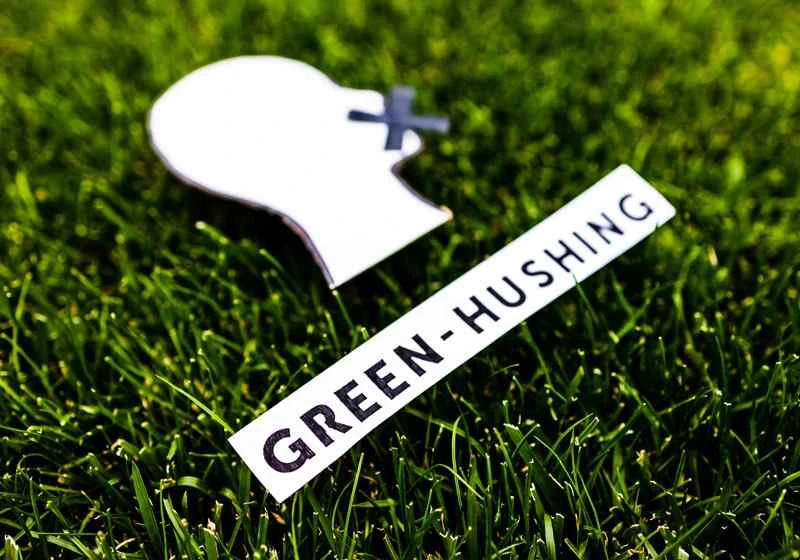
Faced with the risk of greenwashing, some companies choose to stop communicating altogether.
This is known as greenhushing.
This silence may seem prudent, but it is counterproductive:
- it prevents real efforts from being recognized,
- it limits customer education,
- it slows down the dissemination of good industrial practices.
👉 The right balance is neither exaggeration nor silence, but communicating methodically and transparently.
The principles of credible communication about your eco-design approach
Communicating about an eco-design approach is not about “greening” marketing rhetoric. It is about explaining an industrial process, technical choices, and real trade-offs.
Credible communication does not seek to hide limitations, but to make the approach clear, understandable, and verifiable for its stakeholders: customers, partners, investors, and buyers.
Say what has been done, not what is hoped for.
Credible communication is based on existing, measurable, and verifiable actions.
Future objectives may be mentioned, provided they are clearly presented as such and not as achievements.
Take a gradual approach
Eco-design is not a perfect state, but a journey.
Explaining the steps already taken, the choices made, and those still to come is often more credible than a claim to be “100% responsible.”
Contextualize the results
Impact reduction only makes sense if the scope, method, and limitations are clearly stated.
Without this context, the figures become ambiguous and can fuel suspicion of greenwashing.
What tools can be used to communicate without greenwashing?
Before talking about commitment, it is necessary to be able to demonstrate what has been done, why, and with what real impact.
Eco-design diagnosis: structuring your approach
Before communicating, it is essential to know where to take action and on which levers to focus your efforts.
This is precisely the role of the Eco-design Diagnosis, offered by Bpifrance and ADEME, and carried out by Altyor’s sustainable development experts.
This assessment is not a simple environmental audit.
It is a structured support system designed to help companies move from intention to action.
In concrete terms, the Eco-design Diagnosis is based on several key steps:
- Training for teams and management to align strategic, technical, and environmental issues.
The goal: to share a common foundation of understanding and get the entire organization on board. - Life Cycle Assessment (LCA) modeling of the existing product, based on actual data: materials, processes, transportation, use, end of life.
This step makes it possible to quantify environmental impacts and move beyond preconceived notions. - Identifying the phases that contribute the most, often where you least expect them: manufacturing, transportation, component selection, or end of life.
- Concrete eco-design recommendations, prioritized and discussed with the teams.
At this stage, several improvement scenarios are developed. - A new environmental assessment, incorporating these scenarios, to accurately measure the potential gains.
- An initial technical and economic assessment to link environmental performance, industrial feasibility, and cost impacts.
👉 The result: informed decisions based on numerical comparisons and a solid foundation for factual communication.
Discover the Eco-Design Diag
Concrete solutions to reduce your product’s environmental footprint
LCA as a reference framework
Life Cycle Assessment (LCA) is currently the most robust and recognized tool for objectively assessing a product’s environmental impact.
Unlike a partial approach, LCA analyzes the entire life cycle:
- extraction of raw materials,
- manufacture,
- transport,
- usage phase,
- end of life.
This comprehensive view is essential to avoid simplistic or misleading arguments.
A material that is more environmentally friendly on paper may, for example, have a greater impact during its processing or transport.
Thanks to LCA, it is now possible to:
- objectively compare several design scenarios,
- prioritize the most effective levers for improvement,
- base environmental communication on quantifiable and verifiable indicators.
This is also the basis for Type III environmental declarations (ISO 14025), EPDs, and FDESs.
In other words, LCA transforms eco-design into a common language between engineering, management, and communication.
Measure the real impact of your product.
Life cycle assessment (LCA) reveals where your product’s environmental impact really lies, and where you can take action to make a difference. 14 answers to help you understand the method and focus your efforts where they’re most needed.
ISO standards and labels: how to regulate your environmental claims
To ensure the reliability of environmental communication, ISO standards 14020 to 14025 define three main types of claims, according to their level of evidence.
Type I (ISO 14024)
Official environmental labels
These labels are issued by independent third-party organizations, based on verified multi-criteria standards.
Examples:
👉 Very credible, but demanding and best suited to consumer products.
Type II (ISO 14021)
Environmental self-declarations
These are claims made by the company itself, without third-party certification, but strictly regulated.
Examples permitted if justified:
- “contains X% recycled material”
- X% weight reduction
- recyclable packaging
👉 Vague or general terms are prohibited. Data must be accurate, measurable, and justifiable.
Type III (ISO 14025)
Quantified environmental statements
Type III declarations (EPD, FDES) are based on a comprehensive LCA, with a detailed environmental profile (CO₂, resources, water, energy) verified by an independent third party, according to common rules that allow for comparison between products.
Mainly used in construction, industry, and B2B purchasing, they are aimed at professionals and involve a demanding, lengthy, and costly procedure that is often inaccessible to SMEs at first glance.
👉 This is the most robust level of communication, but also the most demanding.

Communicating about eco-design is neither a green marketing exercise nor a cosmetic operation.
It is a structured approach based on facts, methods, and evidence.
Companies that structure their communications transform regulatory constraints into a sustainable competitive advantage.
Those that improvise expose themselves to the risk of negative publicity and real legal risks.
👉 The key is not to “greenwash” your message, but to develop an approach before promoting it.
Custom Quote · Response Within 48 Hours
Get a quote tailored to your project
There’s no magic formula, just an accurate estimate prepared by our experts after we’ve understood your needs.
✓ Response within 48 hours ✓ NDA signed in advance ✓ No obligation