


How to Choose
your connectivity and radio protocol?
The Tech guide from Altyor’s experts
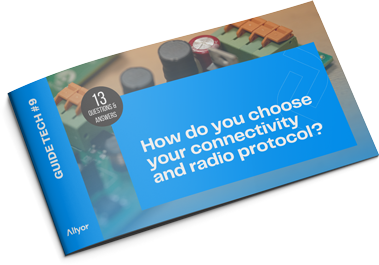
13 questions to help you choose the right IoT protocol
Are you launching a connected device project and can’t decide between LoRaWAN, NB-IoT, BLE, Zigbee, Matter, Wi-Fi, or UWB? The list is long, and the choice is never neutral.
Make the wrong choice, and you’ll see battery life plummet, your carrier bill skyrocket, or your product stop working as soon as it crosses a border. Conversely, choosing a connectivity solution based on your actual use case ensures a smooth development process, successful certification, and controlled costs throughout your product’s entire lifecycle.
The choice of radio protocol is a fundamental decision
In a smart device, the wireless technology plays a major role in shaping the product. The chosen protocol has a direct impact on:
- the battery life and capacity of the power source,
- the actual range once the product is installed in the field,
- the product’s latency and responsiveness,
- the target markets and required certifications,
- the total cost of ownership, including subscriptions,
- compliance with the Cyber Resilience Act.
A decision made too quickly, based solely on a technical specification sheet, often leads to:
- batteries that need to be replaced much sooner than expected,
- insufficient coverage behind a load-bearing wall or a metal cabinet,
- a radio board variant discovered after mass production,
- subscriptions that weigh on the fleet’s profitability,
- dependence on a standard whose long-term viability is uncertain.
What you will learn in this guide
In this practical guide, the Altyor team shares 13 specific questions you should ask yourself before even opening a module datasheet.
You will discover:
- How to use the actual use case (fixed or mobile object, indoor or outdoor, distance, power source) to define connectivity requirements
- Why the advertised line-of-sight range isn’t enough, and what signal losses to expect in reinforced concrete, underground, or in a dense Wi-Fi environment
- How to set the target latency to eliminate some options from the outset
- How to calculate power consumption over a full cycle and match the protocol to its power source
- What distinguishes Sub-GHz from 2.4 GHz, and why ISM bands vary by continent
- How to check roaming and NB-IoT/LTE-M coverage internationally
- Which cost items are often overlooked, and how to decide between a carrier subscription and a private network
- How to assess the long-term viability of a radio standard and prepare for the cyber resilience act when selecting a protocol
This guide helps you make informed decisions about different technologies before your choices become irreversible.
Download your guide
Do you have a smart device project? Let’s talk about it
Are you trying to decide between several radio technologies, do you want to verify your product’s range or battery life, or are you preparing its certifications for multiple markets?
The Altyor teams support IoT project leaders from the earliest stages, from choosing the connectivity solution all the way through production.
← Previous: Specifications Guide
From design to industrialization, production and remanufacturing,
We offer ongoing, customized global support to ensure the success of your project.
Innovation support
_Building a solid foundation for your industrial project
Mechanical electronic design
_Giving lasting life to your product
Industrialization
_Industrializing your product to make your production more reliable
Manufacturing
_Implementing your robust production line
Remanufacturing
_Supporting your product's life cycle